
















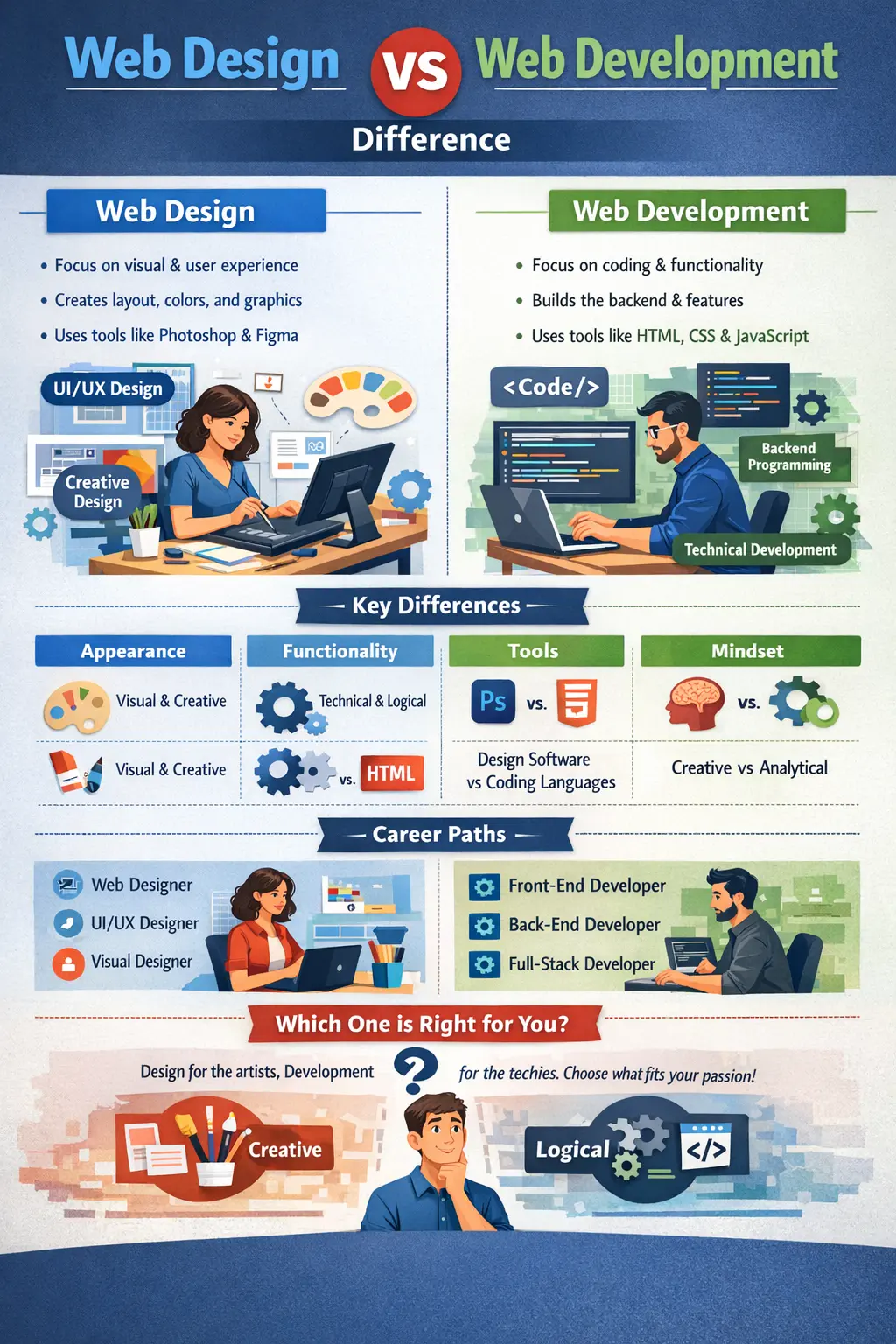
Web Design VS Web Development: Difference <\/h2>Introduction to Website Creation
In today’s digital era, websites are the backbone of almost every business, brand, and personal identity. Whether it’s an online store, a portfolio, a blog, or a corporate website, the internet has become the primary space where people discover, evaluate, and trust brands. Behind every successful website, two critical disciplines are working together—web design and web development.Although these terms are often used interchangeably, they represent two completely different skill sets and responsibilities. Understanding the difference between web design and web development is crucial not only for career aspirants but also for business owners who want to build effective digital products. Simply put, one focuses on how a website looks and feels, while the other focuses on how it works and performs.
Why People Often Confuse Web Design and Web Development
The confusion between web design and web development mainly arises because the end product—a website—appears as a single entity to users. When you open a website, you see colours, layouts, images, buttons, and content all functioning together seamlessly. This makes it easy to assume that one person or one role handles everything.However, just like a movie requires both actors and behind-the-scenes technicians, a website needs designers and developers. Designers shape the visual story, while developers build the technical foundation. Without understanding this separation, people often misunderstand job roles, skill requirements, and even salary expectations.
Importance of Understanding the Difference
Knowing the difference between web design and web development helps in multiple ways. If you are a student, it helps you choose the right career path based on your strengths. If you are a business owner, it ensures you hire the right professionals for your project. If you are a freelancer, it allows you to position yourself clearly in the market.More importantly, understanding this difference saves time, money, and frustration. A beautifully designed website that doesn’t function properly will fail. Similarly, a technically perfect website with poor design will struggle to attract users. Balance is key.
What is Web Design?
Definition of Web Design
Web design refers to the process of creating the visual layout, structure, and overall user experience of a website. It focuses on aesthetics, usability, and interaction. Web designers decide how a website should look, how content should be arranged, and how users should navigate through different pages.At its core, web design is about making websites visually appealing while ensuring they are easy and enjoyable to use. A good design silently guides users without confusing them.
Role and Responsibilities of a Web Designer
A web designer’s primary responsibility is to create designs that communicate clearly and effectively. This includes selecting colour schemes that align with branding, choosing readable fonts, designing layouts that look good on all devices, and ensuring visual consistency throughout the website.Web designers often start with wireframes and mock-ups before moving to high-fidelity designs. They also think deeply about user behaviour—where users will click, how they will scroll, and what will grab their attention. Their work directly influences how long users stay on a website and whether they trust it.
Visual Design, UX, and UI Explained
Web design includes User Interface (UI) and User Experience (UX) design. UI focuses on the appearance of elements like buttons, icons, menus, and forms. UX focuses on how users feel while interacting with the website—whether the experience is smooth, intuitive, and frustration-free.Great UX design is invisible. When users can easily find what they need without thinking too much, the designer has done their job well.
What is Web Development?
Definition of Web Development
Web development is the technical process of building and maintaining websites using programming languages, frameworks, and databases. While designers create the blueprint, developers bring it to life by writing code that makes everything work.Web development ensures that websites load Fast, respond correctly to user actions, and function securely across different devices and browsers.
Role and Responsibilities of a Web Developer
Web developers convert static designs into interactive websites. They handle features such as login systems, contact forms, payment gateways, databases, and server communication. Developers also focus on performance optimisation, security, and scalability.Their job is not just to make things work—but to make them work efficiently, reliably, and safely.
Frontend, Backend, and Full-Stack Development
Frontend developers work on what users see and interact with directly. Backend developers manage servers, databases, and application logic. Full-stack developers handle both frontend and backend, making them highly versatile and in-demand professionals.
Web Design vs Web Development: Core Differences
Design vs Functionality
Web design focuses on the appearance and experience of a website, while web development focuses on functionality and performance. Designers answer the question “How should this look?” Developers answer “How should this work?”Both are equally important and deeply interconnected.
Creativity vs Logic
Web designers rely heavily on creativity, visual storytelling, and emotional appeal. Web developers rely on logical thinking, structured problem-solving, and technical precision. One is artistic, the other is analytical.
Tools and Technologies Compared
Designers use visual tools, while developers use programming languages and development environments. Their tools differ, but their goals align—to create a high-quality website.
Skills Required for Web Design
Technical and Creative Skills
Web designers need a strong understanding of design principles such as balance, contrast, alignment, and typography. They must also understand responsive design so websites look good on mobile, tablet, and desktop screens.Creativity alone is not enough—designers must think strategically and user-first.
Soft Skills for Web Designers
Communication skills are vital. Designers must understand client requirements, accept feedback, and collaborate with developers. Empathy plays a big role in UX design.
Skills Required for Web Development
Programming and Technical Skills
Web developers must master coding languages and frameworks. They need to understand how systems interact, how data flows, and how to debug errors efficiently.Technology evolves constantly, so continuous learning is a must.
Problem-Solving Skills for Developers
Developers face challenges daily—from broken code to performance issues. Strong analytical thinking and patience are essential to succeed in this role.
Tools Used in Web Design
Design and Prototyping Tools
Designers commonly use tools like Figma, Adobe XD, Photoshop, and illustration to create layouts, prototypes, and visual assets before development begins.
Tools Used in Web Development
Programming Languages and Frameworks
Developers work with HTML, CSS, JavaScript, React, Angular, PHP, Python, Node.js, and Databases. These tools form the backbone of modern websites.
Career Opportunities in Web Development
Job Roles and Growth Path
Web developers can advance into senior developer, software engineer, architect, or CTO roles. Demand remains strong across industries.
Learning Curve and Difficulty Level
Is Web Design Easy to Learn?
Web design is easier to start, but mastering design thinking and UX takes time and experience.
Is Web Development Hard to Learn?
Web development has a steeper learning curve, but offers excellent long-term career growth.
Which Career Should You Choose?
Choose web design if you enjoy creativity, visuals, and user experience.
Choose web development if you enjoy coding, logic, and technical challenges.
Conclusion
The debate of Web Design vs Web Development is not about superiority—it’s about suitability. Web design shapes the visual and emotional experience, while web development ensures Functionality and performance. Both careers are highly valuable, future-proof, and rewarding. The best choice depends on your interests, strengths, and long-term goals.
Choose web development if you enjoy coding, logic, and technical challenges.
Recently Added Articles


.webp)










.png)



 Book A Free Demo
  18001020418
 Apply Now





 Please select course category