
















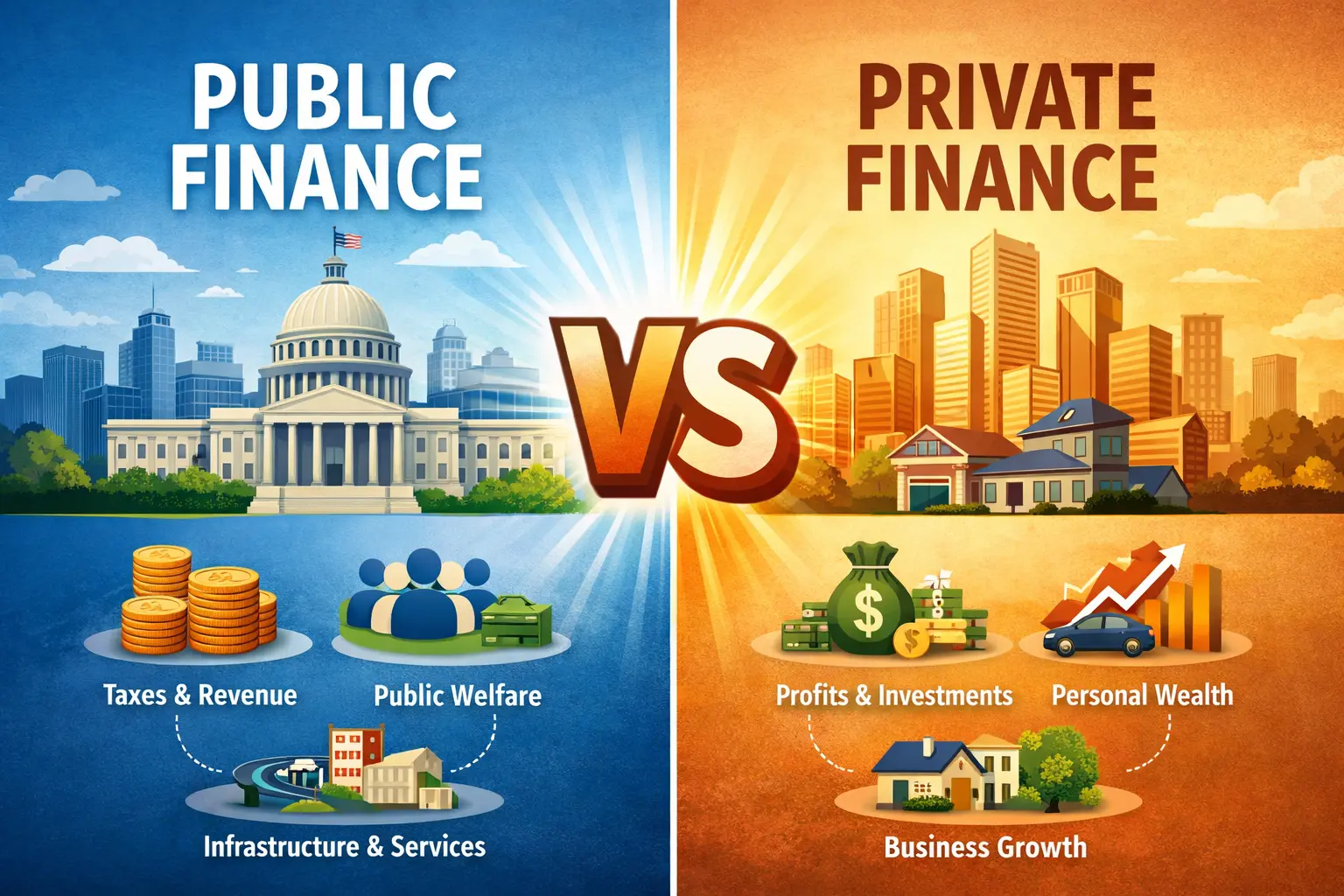
Introduction to Public and Private Finance
Understanding the difference between public and private finance is essential for anyone studying economics, commerce, public administration, or business management. Finance plays a crucial role in managing resources, whether it is for a government or an individual. While both public and private finance deal with income, expenditure, and savings, their objectives, sources, and management styles differ significantly. This article explores the difference between public and private finance in a clear and structured way to help readers grasp the concept easily.
Meaning of Public Finance
Public finance refers to the management of income, expenditure, and debt of government bodies such as the central, state, and local governments. It focuses on generating revenue through taxes, fees, and public enterprises to fund public welfare activities. To fully understand the difference between public and private finance, it is important to note that public finance prioritizes social welfare over profit. Its main aim is economic stability, development, and equitable distribution of wealth.
Meaning of Private Finance
Private finance deals with the financial activities of individuals, households, and private organizations. It focuses on personal income, savings, investments, and expenditure planning to maximize profits or personal satisfaction. When analyzing the difference between public and private finance, private finance stands out because it is driven by personal goals, such as wealth creation, business growth, and financial security, rather than public welfare.
Objectives of Public and Private Finance
One major aspect of the difference between public and private finance lies in their objectives. Public finance aims to promote social justice, economic growth, and public welfare through government spending on healthcare, education, and infrastructure. In contrast, private finance focuses on maximizing returns, minimizing costs, and achieving financial independence. These contrasting objectives shape how funds are collected and spent in both systems.
Sources of Income
The difference between public and private finance is clearly visible in their sources of income. Public finance relies on taxes, duties, fines, and public borrowing to generate revenue. Private finance depends on salaries, business profits, investments, and interest income. Governments have the authority to impose taxes, whereas individuals and private firms must earn income through productive activities.
Nature of Expenditure
Another important difference between public and private finance is the nature of expenditure. Public expenditure is generally large-scale and aimed at long-term social benefits, such as infrastructure development and public services. Private expenditure is more limited and focuses on personal needs, business expansion, or lifestyle improvement. Governments may spend even when returns are not immediate, while private entities focus on cost-benefit outcomes.
Budgeting and Deficit Management
Budgeting is a key area that highlights the difference between public and private finance. Governments may deliberately run budget deficits to stimulate economic growth or manage crises. Private individuals and businesses, however, usually try to avoid deficits as they can lead to financial instability. Public finance allows deficit financing as a policy tool, while private finance emphasizes balanced or surplus budgets.
Flexibility and Decision-Making
The difference between public and private finance is also evident in flexibility and decision-making. Public finance decisions are influenced by political, social, and economic factors and require legislative approval. Private finance decisions are more flexible and can be made quickly based on market conditions or personal priorities. This makes private finance more adaptable, while public finance follows structured procedures.
Conclusion
In conclusion, the difference between public and private finance lies in their purpose, income sources, expenditure patterns, and financial management approaches. Public finance focuses on societal welfare and economic stability, while private finance centers on individual or organizational financial growth. Understanding these differences helps students, professionals, and policymakers make informed financial and economic decisions in both public and private sectors.
For more information, visit our site
Recently Added Articles

.webp)










.png)



 Book A Free Demo
  18001020418
 Apply Now





 Please select course category