













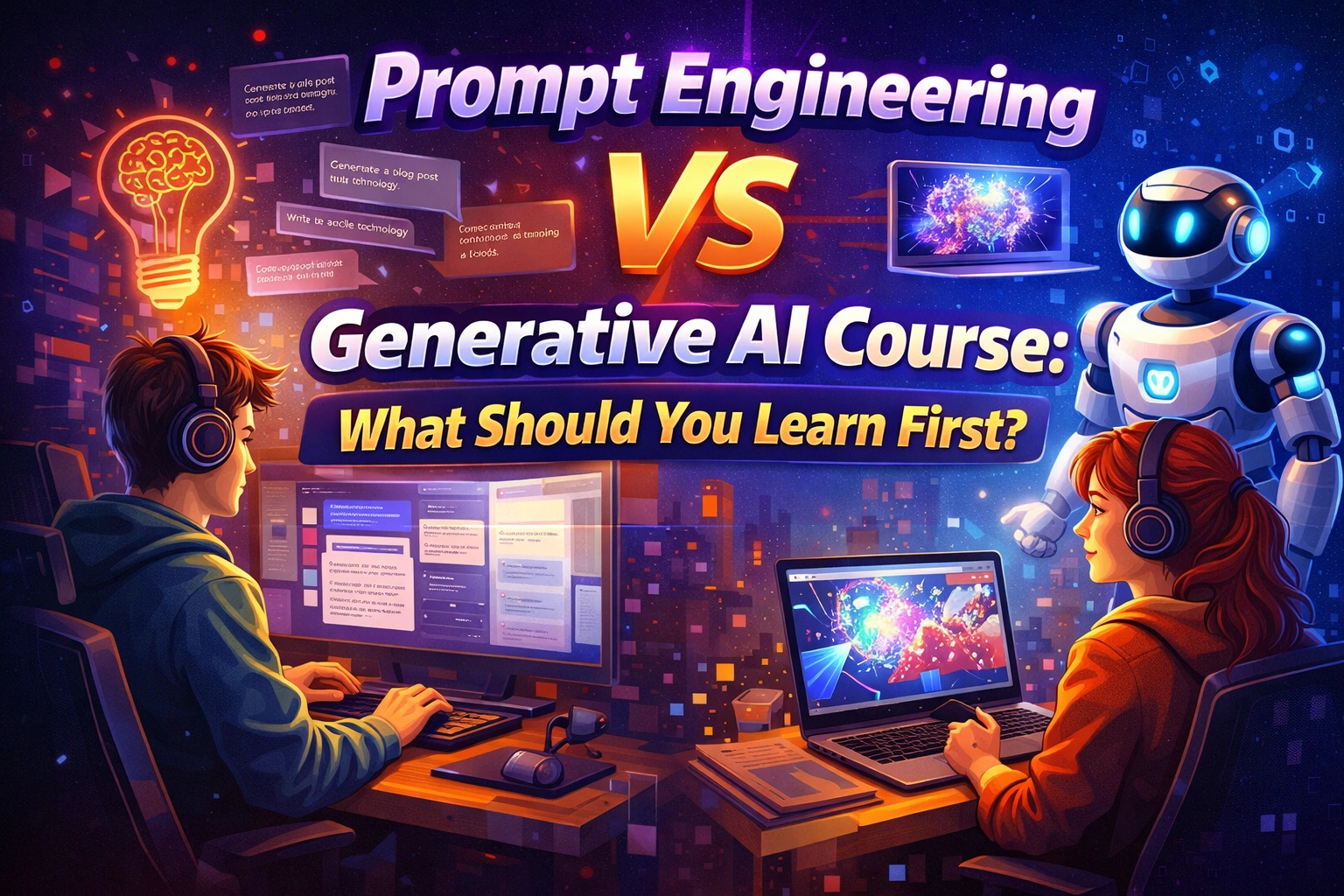
Prompt Engineering vs Generative AI Course: What Should You Learn First?
Last updated on Mar 21, 2026


Introduction
Artificial Intelligence is evolving rapidly, and two of the most talked-about areas today are prompt engineering and generative AI. As students and professionals explore opportunities in AI, a common question arises: What should you learn first—prompt engineering or a full generative AI course?
Both fields are closely related and play important roles in modern AI applications. Prompt engineering focuses on interacting effectively with AI tools, while generative AI involves building systems that can create content such as text, images, videos, and code. Understanding the difference between these two paths is essential for choosing the right learning approach.
For beginners and aspiring professionals, selecting the right starting point depends on their goals, technical background, and career interests. By understanding how these fields work and what skills they require, students can make informed decisions and build strong foundations in artificial intelligence.
Understanding Prompt Engineering
Prompt engineering is the process of designing and structuring inputs (prompts) to get accurate, relevant, and high-quality outputs from AI models. It involves learning how to communicate effectively with AI systems to generate desired results.
In simple terms, prompt engineering teaches users how to “ask the right questions” of AI tools. This skill is particularly useful for working with AI platforms that generate text, images, or code based on user input.
Prompt engineering does not require deep programming knowledge, making it an excellent starting point for beginners. Students from non-technical backgrounds, such as commerce, marketing, or design, can easily learn prompt engineering and start using AI tools effectively.
It is widely used in industries such as content creation, digital marketing, customer support automation, and research. Professionals who master prompt engineering can significantly improve productivity and efficiency by leveraging AI tools.
Understanding Generative AI Courses
Generative AI focuses on developing and working with AI models that can create new content. This includes generating text, images, videos, music, and even software code. A generative AI course typically covers topics such as machine learning, deep learning, neural networks, and natural language processing.
Unlike prompt engineering, generative AI requires a deeper understanding of technical concepts and programming skills. Students often learn programming languages such as Python and work with AI frameworks and tools to build and train models.
Generative AI courses are suitable for students who want to pursue technical roles such as AI engineer, machine learning developer, or data scientist. These courses provide a comprehensive understanding of how AI systems are designed, developed, and optimized.
While generative AI is more complex, it offers advanced career opportunities and allows individuals to create innovative AI-powered solutions.
Key Differences Between Prompt Engineering and Generative AI
Although both fields are part of artificial intelligence, they differ in terms of complexity, skills required, and career applications.
Prompt engineering is primarily focused on using existing AI tools effectively. It is easier to learn and requires minimal technical knowledge. This makes it ideal for beginners or professionals who want to integrate AI into their current roles.
On the other hand, generative AI involves building and understanding AI models from a technical perspective. It requires knowledge of programming, algorithms, and data analysis. This makes it more suitable for students with technical backgrounds or those willing to learn advanced concepts.
In terms of career scope, prompt engineering is often used in roles related to content creation, marketing, and business operations. Generative AI, however, is more aligned with technical careers in software development, data science, and AI research.
What Should You Learn First?
Choosing between prompt engineering and generative AI depends on your goals and current skill level.
For beginners, especially those without a technical background, starting with prompt engineering is often the best choice. It provides a quick introduction to AI tools and helps build confidence in using artificial intelligence in practical scenarios. Students can start applying their knowledge immediately in areas such as content creation, marketing, and business tasks.
Once students become comfortable with AI tools, they can gradually move towards learning generative AI concepts. This step-by-step approach allows learners to build a strong foundation before diving into complex technical topics.
For students with a technical background or a strong interest in programming, starting directly with a generative AI course may be suitable. However, even in this case, understanding prompt engineering can enhance their ability to interact with AI models effectively.
Career Opportunities in Both Fields
Both prompt engineering and generative AI offer valuable career opportunities in the modern job market.
Prompt engineering is increasingly used in roles such as content strategist, AI content creator, digital marketer, and business analyst. Professionals in these roles use AI tools to improve productivity, generate content, and automate tasks.
Generative AI, on the other hand, opens doors to technical careers such as AI engineer, machine learning specialist, data scientist, and AI developer. These roles involve designing AI systems, training models, and developing intelligent applications.
As AI continues to grow, professionals who understand both prompt engineering and generative AI will have a strong advantage in the job market. Combining these skills allows individuals to work across both technical and non-technical domains.
Building a Learning Path in AI
Students who want to build a successful career in artificial intelligence should adopt a structured learning approach. Starting with basic concepts and gradually moving to advanced topics helps in developing a strong understanding of AI technologies.
A recommended learning path may begin with digital literacy and basic AI tools, followed by prompt engineering to understand how AI systems respond to inputs. After gaining confidence, students can move on to learning programming, machine learning fundamentals, and generative AI techniques.
Practical experience is also essential. Working on projects, experimenting with AI tools, and building portfolios help students demonstrate their skills to potential employers.
Continuous learning is key in the field of artificial intelligence, as technologies and tools evolve rapidly.
Frequently Asked Questions (FAQ)<\/h2>What is prompt engineering?
Prompt engineering is the process of creating effective inputs for AI systems to generate accurate and relevant outputs.
What is a generative AI course?
A generative AI course teaches how to build and work with AI models that can generate content such as text, images, and code.
Which is easier to learn, prompt engineering or generative AI?
Prompt engineering is easier to learn because it requires less technical knowledge, while generative AI involves programming and advanced concepts.
Can non-technical students learn generative AI?
Yes, but they may need to first learn programming basics and foundational AI concepts before moving to advanced topics.
Should I learn both prompt engineering and generative AI?
Yes, learning both provides a comprehensive understanding of AI and increases career opportunities in both technical and non-technical roles.
Conclusion<\/h2>
Prompt engineering and generative AI are both important areas in the field of artificial intelligence, each offering unique learning opportunities and career paths. While prompt engineering focuses on effectively using AI tools, generative AI involves building and understanding complex AI systems.
For beginners, starting with prompt engineering provides an easy entry point into the world of AI. It allows students to gain practical experience and build confidence before exploring more advanced topics. As learners progress, transitioning to generative AI can open up technical career opportunities and deeper knowledge of artificial intelligence.
By choosing the right learning path and focusing on continuous skill development, students can successfully navigate the AI landscape and build rewarding careers in this rapidly growing field.
Recently Added Articles


.webp)










.png)



 Book A Free Demo
  18001020418
 Apply Now





 Please select course category